
· By Nick Fernandez
Native Advertising Should Be Judged by What Happens After the Click
Key Takeaways
- CTR says little about what a native click is worth.
- Score disclosure, viewability, attention, and post-click behavior together.
- Page clutter can make "compliant" impressions worthless.
- Holdouts prove lift; attribution often overstates it.
- Attention metrics help but are still maturing.
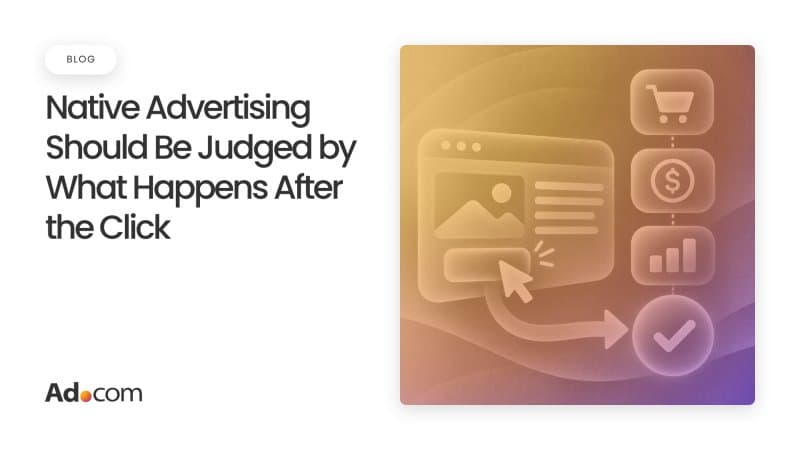
Native advertising often focuses too much on click-through rates, which can be misleading for budget owners. A click alone does not guarantee meaningful engagement or conversions. It could come from an interested reader, an accidental tap, or even a bot. The real value becomes clear only when you see what visitors do after reaching the landing page.
Buyers need a scorecard that follows the user past the click and weights each metric by how hard it is to fake. In this blog, we build that native advertising scorecard, show how to test it, and flag where it falls short.
Why Native Advertising Needs a Post-Click Standard
Native advertising is built to sit inside content, which makes it easy to click and hard to compare. Front-end metrics can't carry the evaluation alone.
Why Do Blanket CTR Comparisons Mislead?
A recommendation widget, an in-feed card, and a branded article are different products. The IAB Native Advertising Playbook 2.0 splits native advertising into distinct core types judged against campaign goals, not one-click benchmarks.
Stacking native CTR against banner CTR answers the wrong question. A cheap click that bounces in three seconds costs more than a pricier one that converts. That's the heart of how to measure native ads beyond CTR.
How Page Clutter Erodes Post-Click Quality?
The environment shapes what a click is worth. The ANA's Q4 2025 benchmark began tracking ad clutter, ads-to-content ratios, and refresh behavior, finding that compliant impressions can still undercut outcomes.
The older warning stands. ANA's 2023 First Look study found made-for-advertising sites took 21% of impressions and 15% of spend. Native advertising on pages like that posts clicks, not customers.
The Native Ad Measurement Scorecard
A useful scorecard mixes pre-click and post-click signals and weights post-click quality more heavily. Adapt it to your funnel.
Layer | Metric | What it tells you | Standard or baseline | Suggested weight |
Pre-click | Disclosure clarity | Users know it's paid | IAB and FTC guidance | Pass/fail gate |
Pre-click | Viewable rate | Ad could be seen | MRC 50% of pixels, one second | 10% |
Pre-click | Attention metric | Depth of exposure | IAB/MRC guidelines | 15% |
Post-click | Engaged sessions | Real reading | Your site baseline | 25% |
Post-click | Scroll depth | Page kept the promise | Your site baseline | 15% |
Post-click | Incremental conversions | Business value | Holdout test | 35% |
Treat the weights as a starting point for native ad measurement. Shift them toward conversions for performance goals and engagement for consideration.
Pre-Click Signals Worth Keeping
Native ad disclosure is a gate, not a score. The FTC's 2015 enforcement policy expects people to recognize native ads as advertising before clicking, and IAB guidance has long put clear, prominent disclosure first.
Viewability against the MRC standard and attention come next. They don't prove value, but they filter out impressions that never had a chance.
Post-Click Quality Metrics That Carry the Weight
Engaged sessions, scroll depth, and return visits show whether the landing page kept the headline's promise. Compare them with your own baseline for similar traffic.
- Engaged sessions versus search traffic
- Share of sessions under 10 seconds, a proxy for accidental taps
- Cost per incremental conversion from a holdout
Bots and stray thumbs inflate CTR cheaply. Faking multi-page engagement is harder, so post-click quality earns most of the weight.
How to Test Native Ad Measurement in Practice
A scorecard is only as good as the test behind it. Two changes do most of the work in native ad measurement.
Match the Landing Page to the Headline
Native headlines often promise an article, then deliver a hard-sell product page. Test a content-led page against your standard one with identical creative.
A hypothetical: an insurer sends one native card to a quote form and to a buyer's guide with a quote tool. If the guide wins on engaged sessions at equal cost per incremental quote, the destination was the problem, not the click.
Prove Lift With a Holdout
Attribution often credits native advertising with conversions that would have happened anyway. Hold out a random audience or region, then compare conversion rates.
Keep it live for the full flight, since short tests reward early luck.
Where Native Ad Measurement Still Falls Short
No native ad measurement framework is neutral, and this one has gaps. Know them before results reach finance.
- Attention is maturing. The IAB and MRC Attention Measurement Guidelines were finalized only in November 2025. At the draft's launch, MRC's Ron Pinelli said they "take a hard step toward separating signal from noise."
- Time misleads. Long time on page may signal confusion, not interest.
- Tracking gaps. Browser limits and consent choices hide some conversions.
- Small samples. Modest budgets may miss real lift.
Putting Ad.com Native on the Scorecard
Ad.com positions Native as placements that complement surrounding content in premium editorial settings and support measurable action. It frames the goal as qualified traffic through less disruptive formats.
Those claims are worth verifying. Run Ad.com Native as its own cell, send it to the same landing pages as your current native advertising partner, and compare post-click quality side by side.
Conclusion
Native advertising earns its budget after the click, not before. CTR and CPC show a format is cheap to engage with; they can't show the engagement was worth buying. A scorecard that gates on disclosure and weights engaged sessions and incremental conversions gives senior teams a defensible way to compare native advertising partners.
It isn't perfect, but it beats stopping at the click. Want to see how your native spend scores? Book a meeting with Ad.com to set up an Ad.com Native test against your current partner.
Frequently Asked Questions
1. What Label Should a Native Ad Carry?
Plain terms like "Sponsored" or "Advertisement" near the headline are safest for native advertising. Vague labels confuse readers and erode trust.
2. Does Native Advertising Work for B2B?
It can, especially in trade publications where readers research purchases. Judge it on sales-accepted leads, not form fills.
3. How Do Recommendation Widgets Differ From In-Feed Native?
Widgets sit beside or below articles and send readers off-site; in-feed units sit inside the content stream. Score them separately.
4. Which Creative Elements Should Be Tested First?
Start with headline and thumbnail, since they set the promise the page must keep. Test one at a time and pick winners on post-click quality.
5. How Often Should the Scorecard Be Reviewed?
Monthly for optimization and quarterly for budget decisions. Re-baseline whenever landing pages, analytics settings, or consent tools change.